Showing posts with label ionizing radiation. Show all posts

Friday, 26 May 2023

Fraudulent and Forever

 I'm going to write a book with the title above. Maybe it won't get past this blog site but it's a start. I want a place to put the information that I'm learning. I want to share difficult concepts in a comprehensive form. This book catalogues my journey from true believer to strong critic. I was misled, I was taught a lie and I believed a lie. Not just one lie but many lies. Uncovering one lie after another, my conclusion is that the nuclear industry is completely fraudulent.

Nuclear power, the power of the atom, is fascinating. The centre of an atom is held together with unimaginable strength – when the nucleus is cracked, like cracking an egg, the energy released can blow up a city or boil water for electricity. It can cause disease or it can heal.


However, it is not “clean, affordable and reliable[1].” The industry uses the media to say the same thing over and over again, so often that many people believe it. Clean? All nuclear power plants must emit radioactive hydrogen. Affordable? Westinghouse and Areva have gone bankrupt over the building of nuclear power plants in the USA and in Finland. Reliable? France has had to buy electricity from Germany during heat waves. When the blackout of 2003 resulted in the shut-down of the nuclear power plants in the affected region, it took more than a week for them to reach full power again. Point Lepreau in New Brunswick has been plagued with outages; refurbishment took over four years during which the plant was offline.


What if the only reason that there are so many supporters of this nefarious industry is that it has marketed itself relentlessly? Like cigarette companies in the 70’s and 80’s, full page ads appear in the magazines. They look like bonafide articles until, with our reading glasses, we identify the small print in the corner that says “advertisement”.  


I’m angry, angry that I was so misled and angry that so many continue to be misled. I’m angry with my profession – with its inability to come to terms with a scourge upon humanity and with its willingness to subvert health of populations to the nuclear industry. I’m also angry with the nuclear industry which has knowingly and purposely misled parliamentarians and populations and lied, denied and misdirected researchers.


Physicians knew that ionizing radiation affected human health from the very beginning of humanity’s interaction with it:

- miners in Czech and their “rotten lungs”

- radiologists in the early 1900’s who used their hands to focus x-rays 

 - dentists and doctors that diagnosed the “radium girls”, the clock painters in the 1920’s

- members of various International ionizing radiation protection associations


The same silence from physicians during atmospheric atomic testing continues in an environment where nuclear power plants emit ionizing radiation (especially tritium). 


The industry knew that ionizing radiation was bad for human health:

- International Atomic Energy Agency lobbied to silence the World Health

 Organization on matters affecting human health – and won in 1957.

- Researchers were fired or had their funds cut when their results didn’t comply with the industry’s sales model. Eg. Dr. John Gofman, Dr. Thomas Mancuso, Dr. Joseph Mangano, Dr. Sternglass, and Dr. Steven Wing. They were then trivialized or their work discredited.

            - Held international meetings on the health of Chernobyl victims behind closed doors. 


In 2009, I met one of the shills for the nuclear industry. He questioned me on my credentials in such a manner that I asked for his name. He coyly said that he was “just a concerned citizen”. Later I learned that he was the President of the Canadian Nuclear Association. 


The new President and CEO for the same CNA, a Mr. John Gorman, a long-time registered lobbyist has met with the government minister in charge with rolling out Canada’s energy plans, Mr. Seamus O’Regan, a recorded eight times. Which leads to the question of whether  Mr. O’Regan sought any opinion other than that of the industry.


Many people feel that they have to leave the decisions about nuclear power to “specialists” to form an opinion on nuclear power. This is not so; a science or engineering degree is not required. All that is needed are two facts. 


Fact one:  Nuclear power is a means to boil water – that is all that it does. Like coal, it boils water and the steam turns the turbines which produce electricity. Anything that will turn turbines would work as well. 


Fact two: The waste lasts for a hundred thousand years. It isn’t just a little poisonous, like a cup of bleach on the counter, it is big time toxic – standing next to a waste fuel rod, a fuel rod that has been “used up” in the reactor, for less than twenty seconds would result in death. This is not science fiction or hyperbole. There have been deaths among people in the early history of nuclear research. Not only is the waste poisonous but everything that the fuel has “touched” during the burning process is also radioactive and toxic. There is no recycling.


Ionizing radiation[2] – the type of radiation produced by nuclear power plants – causes cancers, autoimmune disorders, teratogenic[3] alterations and genetic damage. The nuclear industry itself does not deny this. It is not under contention. The industry simply fudges the truth, and then states that there is a level below which ionizing radiation is not harmful. This is a lie, uncovered countless times most recently by the National Academy of Sciences in its BEIR VII (Biological Effects of Nuclear Radiation) documents of 2007. The nuclear industry has successfully mothballed scientific research and trivialized researchers. It has even jumped past the financial sector to the governmental goldmine. It is truly a fraudulent industry.


The more we learn about small modular reactors, the more we dislike them. The words “recycling” or “reprocessing" are usually associated with the environmental movement but in the case of nuclear waste, the words are "repurposed". After a highly delicate process of dissolving the waste uranium fuel in high-temperature liquid sodium (salt?), the plutonium is separated to be burned as fuel – making more waste and the liquid sodium is now radioactive. 


Meanwhile plutonium is in high demand for the manufacture of nuclear bombs. That the push for SMRs coincides with the build-up of UK nuclear weapons and the refurbishment of those of the USA cannot be an accident. 


Hence, the story ends with the plutonium, the major link between nuclear power and nuclear weapons. Nuclear weapons are suicidal. There are many things that we should be doing with our money instead of proliferating plutonium and arming a second MAD[i] race to the bottom.


[1] Opening statement on the Canadian Nuclear Association website, 20.01.21

[2] The term “radiation” will be used throughout to mean this particular form of radiation, one that produces ions and oxidation products in molecules. The molecules might be in biological entities but also structural objects such as steel and concrete.

[3] Effects on the fetus during development.


[i] Mutually Assured Destruction.  The term "mutual assured destruction", commonly abbreviated "MAD", was coined by Donald Brennan, a strategist working in Herman Kahn's Hudson Institute in 1962. https://en.wikipedia.org/wiki/Mutual_assured_destruction.  Accessed 26.5.2023

Thursday, 15 December 2022

Small Modular Nuclear Reactors


Response to the article “Nuclear energy plays a key role in meeting Canada’s net-zero goals” found in a publication from the Institute for Researach in Public Policy.

Authors David Billedeau and Nicholas Palaschuk are staffers of the Canadian Chamber of Commerce and are certainly welcome to their opinions on nuclear power, but I challenge the two leaps of faith that they make about nuclear energy:

1. That small modular nuclear reactors are legitimate. You will discover that not one has been built if you have the patience to read the World Nuclear Association’s page on small modular reactors. No private investors have put money after them. Fantasy and government subsidies do not make a market.

2. That nuclear power is carbon-emissions free. To fulfill that claim, the industry has to incorporate the carbon “costs” of mining, refining, shipping the uranium to enrichment, in itself requiring the energy of a small city, shipping it back to the reactor, manufacturing the steel and concrete of the reactor, dealing with the waste and, finally, decommissioning, which produces even more radioactive waste. Protecting the environment from radioactivity at the mine sites and the tailings piles should also be added to the carbon cost of nuclear power. (A boiling-water reactor proposed for Saskatchewan will require enrichment, but not all proposed SMRs will. A proposed small reactor in New Brunswick from ARC Clean Technology will have different costs.)

Radioactive pollution is particularly noxious. It occurs at every step of nuclear energy production. Nuclear reactors are not emissions-free. They must vent hydrogen mostly in the form of tritium, which is accompanied by other radioactive pollutants:  krypton, carbon-14, caesium-137, iodine-131 and strontium-90. Tritium and carbon-14 can be taken up by every cell in the human body, bombarding them with radioactive particles or rays. 

In 1962, my physics professor cautioned a group of pro-nuclear students – of which I was one – that nuclear power “had some shortcomings.” We listened respectfully as he described the waste as difficult to contain and hard to accommodate. We thought of him as an “old fuddy-duddy,” unable to embrace our new and wondrous technology. We believed that the smart people who had split the atom would figure out how to take out the garbage. 

They didn’t. They’ve tried for over 70 years.

The current idea is to abandon the waste underground in deep geological repositories. So far, not one is successfully in operation. Two have utterly failed at costs ranging in the billions – in Germany and Carlsbad in New Mexico. Finland, with its Onkalo respository, is the closest to having one be operational but it is having problems with the containers in which the waste will be packaged and has been criticized for siting it on the Gulf of Bothnia.

The industry talks about “reprocessing,” “recycling” and “pyroprocessing,” as if the product is denatured, environmentally friendly and that the waste has magically disappeared. Whatever you might think these processes are, they are not environmentally friendly. 

I am completely in agreement with the writers that nuclear physics, energy and power should be included in our educational curriculums. We must include the ways in which ionizing radiation affects health. With a more educated public, we’d have a more honest discussion about the price we are willing to pay for electrical energy. Are we willing to have radioactive pollution for this purpose? Especially when there are much less harmful sources of energy to exploit? Who speaks for our grandchildren?

Dale Dewar, MD, FCFP, Wynyard, SK

Thursday, 16 June 2022

Physicians: What do we say?


Physicians have been largely silent on
two nuclear industry challenges before the federal government. Do we pour millions of dollars into research and development of Small Modular Nuclear Reactors? Do we bury our current nuclear waste in the vicinity of Wakerton, Teeswater and Kincardine and the city of Ottawa in Ontario?i

In fact, physicians have been silent about nuclear power in general. We have also been silenced as the industry has worked its mysterious media fantasy of “too cheap to monitor” into a myth of “necessity” for climate change energy. We have been silent, not because we have nothing to say but because we’ve been led to believe that these decisions are “political”, not health-related.

During the Canadian Covid epidemic, physicians were utterly unable to keep the primacy of health care out of the political arena. We saw our ICUs worked beyond capacity, and our colleagues quit in frustration. With respect to the threat of ionizing radiation we have been remarkably silent.

To reiterate, the two very different questions currently before Canadian legislators, both involve ionizing radiation, not merely that of nature (sun, rocks, air) but entirely man-made atoms, some of which will still be emitting ionizing radiation in a time-frame that is outside human comprehension (plutonium-239 will be around for 24,100 x 10 yearsii).

1. Nuclear Waste Management:

Having decided that the only way to “manage” nuclear waste was to put it into a Deep Geological Repository (DGR), the Nuclear Waste Management Organization (NWMO)iii has spent the last two of decades searching for such a site. The process has divided communities even while much of negotiation with perceived leaders (mayors, chiefs and council members) has occurred behind closed doors. Health professionals have been silent.

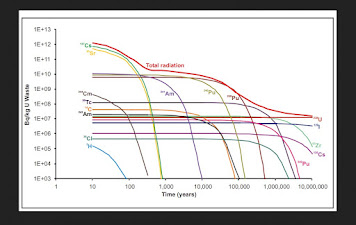
These wastes will be toxic for a long, long time. They are not like ordinary waste simply degrading over time. Each nuclear element has its own decay chain. What is buried in 2030 will never be what it was again. Short-lived waste and decay products will disappear but longer-lived ones will continue to emit radioactivity. A cask of nuclear waste is like a boiling cauldron with atoms of ever-changing elements.

 From this graph, you can see that the total radiation has decreased over 10 million years.


While it is easy to understand that burying the waste in undisturbed bedrock changes the bedrock to a “disturbed” status, many people don’t know that the radioactivity of the waste can change the very containers in which they are buried. Refurbishing of nuclear reactors involves replacement of miles of metal pipes that have become corroded, why would we expect that containers in a DGR would fare better?iv

DGR? This is not the only disposal in question – NWMO is fantasizing a Near Surface Disposal Facilityv (NSDF) at Chalk River only 200 km North of Ottawa. This proposed disposal facility would be an eight story mound that will be within a few hundred metres of the river from which Ottawa and Montreal draw their cities’ drinking water.

vi From

Ionizing radiation directly affects the human genome. No one disputes this but many believe or pretend to believe (denial) that there is a low level at which it is actually beneficial. Hormesis is a fiction.

Physicians often find themselves at odds with an industry when, using the precautionary principle, we hesitate to approve a new drug or technical procedure. For example, thalidomide’s disastrous side effects became evident only after marketing. Our history with radiation in medical use has been a continual story of overuse followed by rationalizing behaviour.

A radiological example, X-rays and CT scans. The overuse of x-rays for removal of skin lesions led to discipline by the American Medical Association at the end of the 1920’s and use for hair removal forbidden. Using x-rays to treat Tinea capitus in Israel resulted in a significant increase in cancers of the head and neck decades later.

In 1996, I joined the multitude of physicians using CT scans “to rule out brain injuries” in children that had bonked their heads – a negative result tended to reassure both the parents and myself, only to discover that these investigations resulted in an increase in cancers years later.vii Choosing Wisely, a program to guide physician decisions about lab and x-ray investigations, now recommends CT scans under a limited number of circumstances – none of which are “I want reassurance” or the “parents expect it.

The industry has settled upon a Deep Geological Repository (DGR). What could be simpler? Bury it deeply in the bedrock where it would be safe and immobile for time immemorial. Are we so brilliant and so prescient that we can know what will be safe for the next 100,000 years and more?

Currently the waste is stored in concrete containers above ground. They can be watched – providing jobs for generations of Canadians – and repackaged if they leak. “Rolling Stewardship” would provide laboratories in Canada and elsewhere with experimental material. Finally, perhaps our brighter descendants will discover a way to use ionizing radiation safely. Instead of choosing a DGR recklessly with our limited understanding of the waste, we have the opportunity to spawn years of research.

2. Building Small Modular Nuclear Reactors:

Full page ads about Small Modular Nuclear Reactors tout them as “safe”. How is anything that produces ionizing radiation safe? We use it extensively in diagnostics and treatment but we also know that it is implicated in causing cancer.

In the 1950’s we routinely x-rayed pregnant women for “pelvimetry”, measuring their bony pelvic outlet to ascertain whether they could give birth naturally or needed a Caesarian section. In both the USA and the UK, the cancer societies noted a rise in leukemia in children. Suddenly there was a boom in building pediatric hospitals devoted to treating cancer.

During the 1940’s and 1950’s, there was a leukemia boom in North Armerica and the UK. There was a sudden increase in incidence from ~ 1:20 to 1:16 children. At that time it was almost always fatal.

Dr. Alice Stewart, a general practitioner in the UK and one of the first epidemiologists, and the Tri-State Health Study in the USA collected data and connected the dots. X-rays during fetal development doubled the incidence of cancer in the offspring. Doctors had been ordering x-rays to measure womens’ pelvises, a series called “”pelvimetry”. The technique disappeared. Lead aprons came out for dental x-rays.

In 2007, after decades of study and six reports, the Biological Effects of Ionizing Radiation (BEIR VII)viii, in publishing its seventh report concluded that any level of exposure to radiation was unsafe (although “at lose doses, the number of radiation induced cancers is small”).

Studies of significant increases in leukemia and other cancers within 5 to 25 km of operating nuclear power plants seem to yield conclusive results but research by both the Committee on Medical Aspects of Radiation in the Environment (COMARE, UK) and the Kikki study in Germany have had disputed by the nuclear industry.

iP. Kaatsch, C.Spix, S. Schmiedel, R. Schulze-Rath, A.Mergenthaler, and M. Blettner, Epidemiologische Studie zu Kinderkrebs in der Umgebung vonKerkraftwerken (KiKK Studie), Sltzgitter: Bundesamp fuer Strablenschutz, 2007, urn:nbn:de:0221-20100317939.

In 2012, I mentioned the German study in discussion after delivering a brief to the Canadian Nuclear Safety Commission (CNSC). The health science person on the board dismissively called the effect “due to a virus.” If there is a special virus that affects only children close to nuclear power plants, we should endeavour to identify it. No such research appears to have been launched.

Before 1990, when it was forced to open its records, the United States Department of Energy not only controlled access to all information on the health effects of radiation on nuclear workers and the public but it also controlled all the funding of radiation researchx. It had successfully stone-walled independent research for decades.

We don’t know which ray or particle will cause any particular DNA molecule to turn the cell into cancer but we know that they do. Physicians have conducted studies on the medical uses of ionizing radiation. Here are a few examples:

a) Xray treatment of Tinea capitus:

The studies on patients who, as children, received x-ray treatment for Tinea capitis (fungal infection of the scalp) in the 1940’s and 1950’s have shown “excess incidences of tumours of the head and neck including the skin, brain, thyroid, and parotid glands”xi. Needless to say, this technique of treating fungal infections is left in the dustbin of history.

b) Breast cancer after fluoroscopic examinations of the breast during treatment for pulmonary tuberculosis:

“The role of ionizing radiation as a cause of carcinoma has long been recognized, particularly in relationship to carcinoma of the skin, lung, thyroid and bone.”xii Dr. Ian Mackenzie in Halifax found fifty cases of breast cancer in patients who had received this form of x-ray treatment prior to 1961. From length of time from the beginning of the x-ray treatments and the breast cancer averaged 17 years. There was also a high correlation between the side of treatment and the cancer-affected breast.

This method of treating pulmonary TB had disappeared by 1955 when antibiotics became available but This research carried out largely on indigenous women and largely had disappeared by 1955. Decades later when they developed breast cancer, I’m sure they were very grateful that they had contributed to show that breast tissue was sensitive to radiation. Should we take a closer look at the use of x-rays in mammograms?

c) PET, MUGA, MIBI and SPECT scans:

All of these scans use a radioisotope, an element that gives off gamma rays that can create images of various parts of the body. For example, I131 concentrates within 15 minutes in the thyroid. This can provide a very good picture of the thyroid. Some studies require two scans, one before the radioisotope is injected and then a later one showing where the element accumulates in the body.

In 2011 researchers in Montreal examined the charts of more than 80,000 patients who had received post-heart attack PET scans and concluded that there was a 3% increase in the incidence of cancer per 10 mSv of scan exposurexiii. Scans require between two and 8 exposures to satisfy the demands of the test. (For comparison, 10 mSv is equivalent to the exposure from 100 chest x-rays).

d) Increased secondary cancers in post-radiation patients:

“Radiation-induced second malignancies (RISM) is one of the important late side effects of radiation therapy”.xiv The exact risk is dependent upon so many factorsxv that it probably contributes only 5% increase of the 17 – 19% total secondary cancers.

What is quite amazing is the real paucity of good prospective research on the health effects of radiation. These ones briefly listed here concentrate on carcinogenic effects, there are other possible affects. Radiation-associated cardiac diseasesxvi is known. Hypertension with its related cardiovascular diseases and strokes has also been identified as associated with chronic exposure to low-dose radiationxvii.

We know that background radiation has health effectsxviii but it seems that limited research has been conducted on diseases other than cancer.

Many of the residents of Port Hope, home to Canada’s uranium refinery since 1933, feel that they have been “researched to death”xix but a casual review of papers shows that many have time-lines that are too short, populations sizes that are too small, and mixed outcomes which do a disservice to all. Quantity of research tells us nothing if it's poorly done.

Finally, the myth believed by many physicians and the public is that we need nuclear power for radioisotopes, for treatment or diagnosis. We do not. We already make radioisotopes more safely in cyclotrons or accelerators and could expand this to all medical radioisotopes.

In conclusion, ionizing radiation is not safe; nuclear power cannot be made safe. Physicians have been altogether too silent about this industry – or, in fact, silenced at its very inception. With the pressure on the government to support an industry that is too slow, too costly and too dangerous to respond to the threatening climate change, who speaks for our great grandchildren?


iBurying nuclear waste requires resources and uses energy as well – currently high grade steel containers covered in copper have been found to be the least likely to corrode. These do not seem to be costed out in either monetary or environmental terms.

iiThe half-life of plutonium-239 is 24,900 years; it takes ten half-lives to disintegrate to almost unmeasurable amounts.

iiiThe Nuclear Waste Management Organization (NWMO, pronounced “Noo-mo”) was formed in 2002 by Canada’s nuclear electrical energy providers as directed by the Nuclear Fuel Waste Act (NFWA). https://nwmo.ca

ivNWMO engineers say that the containers won’t corrode because they are made of the “finest steel” and covered with relatively impervious-to-radiation copper. Does this mean that the tubing in nuciear reactors is not the “finest steel”?

vhttps://www.theglobeandmail.com/canada/article-canada-nuclear-waste-management/

viFrom Geosphere: A blog hosted by the European Geoscience Union. Note that the graph starts at a “zero” of 1000 Bq. https://blogs.egu.eu/network/geosphere/files/2014/12/Untitled.png

viihttps://www.choosingwisely.org/clinician-lists/american-academy-pediatrics-ct-scans-to-evaluate-minor-head-injuries/

viiihttps://nap.nationalacademies.org/resource/11340/beir_vii_final.pdf

ixP. Kaatsch, C.Spix, S. Schmiedel, R. Schulze-Rath, A.Mergenthaler, and M. Blettner, Epidemiologische Studie zu Kinderkrebs in der Umgebung vonKerkraftwerken (KiKK Studie), Sltzgitter: Bundesamp fuer Strablenschutz, 2007, urn:nbn:de:0221-20100317939.

xhttps://www.sfgate.com/bayarea/article/Alice-Stewart-her-research-led-to-end-of-2800048.php

xiFollow-up study of patients treated by X-ray epilation for Tinea capitis: https://pubmed.ncbi.nlm.nih.gov/1244805/

This paper is merely one of many on this subject.

xii J. A. Myrden, J. E. Hiltz, “Breast Cancer Following Multiple Fluoroscopies During Artificial Pneumothorax Treatment of Pulmonary Tuberculosis”, Canad. Med. Ass.J., June 14, 1969, vol 100

xiiiMark J. Eisenberg, Johathan Afilalo, Patrick R. Lawler, Michal Abramhamowicz, Hugues Righard, and Louise Pilot, “Cancr Risk Related to Low-Dose Ionizing Radiation from Cardiac Imaging in Patients after Acute Myocardial Infarction”, Canad. Med. Ass. J, 183(March 8, 2011); 430-436.

xivChinna Babu Dracham, Abhash Shankar, and Renu Madan,”Radiation induced secondary malignancies: a review article” Radiat Oncol J. 2018 Jun; 36(2): 85–94. https://www.ncbi.nlm.nih.gov/pmc/articles/PMC6074073/

xv For example: age at radiation, dose and volume of irradiated area, type of irradiated organ and tissue,

radiation technique, individual and family history of cancer, chemotherapy, cigarette-smoking, diet and

external environment.

xviMilind Y. Desai, “Radiation Associated Cardiac Disease”, American College of Cardiology, June 21, 2017. https://www.acc.org/latest-in-cardiology/articles/2017/06/13/07/13/radiation-associated-cardiac-disease

xviihttps://www.heart.org/en/news/2019/05/03/regular-low-level-radiation-exposure-raises-high-blood-pressure-risk

xviiiBen Spycher, Judith Lupatsch, Marcel Zwahlen, Martin Roosli, Felix Niggli, Michael Grotzer, Johannes Rischewski, Matthias Egger, Claudia Kuehni, for the Swiss Pediatric Oncology Group and the Swiss national Cohort Study Group, “Background Ionizing Radiation and the Risk of Chilhood Cancer: A Census-Based Nationwide Cohort Study”, Environmental Health Perspectives, June 1, 2015. https://ehp.niehs.nih.gov/doi/full/10.1289/ehp.1408548

xixPersonal communication with Port Hope citizen


Thursday, 7 June 2018

Small Modular Reactors

“War as Disease”

When I was contacted this past winter about speaking at the CPRA conference in Regina, I said that I had been a keynote when the conference was in Fredericton and I hadn’t really done any further work on my thesis that “War is Disease” but that I had been giving a lot of thought to how that, War, had affected the environment and future generations.

So I offered the topic:

Rights for a Safe Environment for our children – clean air, clean water, clean playgrounds.  It seemed that children were the most affected by their warring parents and they had the least say in the matter.  So what we do with the environment and our behaviour in the world has a lot to do with whether children have clean air, clean water and safe playgrounds.

When I went back to prepare for today, I looked up the UN Convention on the Rights of Children (https://www.ohchr.org/EN/ProfessionalInterest/Pages/CRC.aspx). I also asked children and their parents about the future. There didn’t seem to be anything that united my passion for peace, for a clean environment and for children’s rights. An item in the newpaper offered something that did – the sudden federal and Saskatchewan provincial love affair with Small Modular Nuclear Reactors and the vision of sprinkling these all over the country like microwave ovens.

Which segues to a particular type of pollution with which playgrounds of the world are already becoming affected. And what that type of pollution means for our children’s children’s children’s children – and so on.

 
This map was created using the Comprehensive Test Ban Treaty monitors and illustrates the spread of Caesium-137 after Fukushima.

Caesium-137 is a radioactive type of cesium, not a naturally occurring element, produced only by nuclear reactions. The presence of caesium-137 indicates that there has been a nuclear power plant accident or a detonated nuclear weapon. It is present in everyone who was born after the 1950’s.

Caesium-137 was picked up by the Comprehensive Test Ban Treaty monitors around the world after the Fukushima accident. In a month’s time no place on earth will not have received a dose of Cs-137. Non-radioactive or normal cesium-133 is considered mildly toxic to biological cells where it acts like potassium.

Caesium-137 has a half-life of about 30 years. This means that one half of the caesium-137 will have decayed to barium-137m through to non-radioactive barium in thirty years. Because it acts like potassium biologically, it has a biological half-life which is relatively short, between 50 and 150 days, but during which it emits beta particles and gamma rays to muscles, heart, pancreas and brain – in fact, no organ is unaffected.

Note that barium has no biological function; small amounts dissolved in water are toxic. It will substitute for calcium in bones and in muscle function. A human cell that is using caesium like potassium in ion exchange will have a sudden challenge because the caesium has changed into barium – which cannot perform the same action.

The nuclear industry – whether bombs or nuclear power – has never increased safety levels of radioactive exposure without civilian non-industry intervention.

In the 1950’s and 60’s, over 500 nuclear bomb tests spread caesium-137 and strontium-90 around the world and most heavily in areas referred to as “downwind”. It took the fury of thousands of people collecting the discarded baby teeth of their children to convince governments to shut down atmospheric bomb testing. Baby teeth contained strontium-90.

The human body can’t discriminate between calcium and strontium so strontium-90, once absorbed by the blood stream goes to bones and teeth, becoming part of the structure. Strontium-90 is a new element found only since the atmospheric testing.

Strontium-90 is a “bone seeker” and about 75% of ingested strontium – in cow or goat milk, meat, and vegetables – will simply pass through with feces but the remainder is preferentially deposited in bones and teeth. Its presence can cause bone cancer or leukemia.

As Strontium-90 decays, it becomes first another radioisotope, yttrium-90, and 64 hours later, zirconium-90. Yttrium is medically significant in the treatment of cancer because of its short half-life and high-energy β− decay but this is not a useful attribute in normal cells. In short, strontium-90 has a decay step that is disruptive to normally operating human cells making strontium-90 doubly dangerous. 

The radioactive pollution from nuclear power plants and bombs includes iodine-131. This is probably the most feared and discussed part of the fall-out, everyone wondering whether or when they should take their iodine pills to try to prevent thyroid cancer. That there is a connection there is no doubt. Thyroid cancer sky-rockets wherever there is radioactive fall-out; usually peaking at about five years post-accident.

What does ionizing radiation do within biological structures? It changes them. It makes ions – it splits molecules into pieces. It doesn’t matter whether ionizing radiation is from the sun, from x-rays or from a nuclear power plant, and it doesn’t matter whether it is alpha, beta or gamma radiation. To some extent the ionizing radiation will change enzymes and other structures within the cell.
It has been known since 1927 that ionizing radiation caused mutations in the reproductive cells of fruit flies; Robert Muller received a Nobel Prize in the 1940’s for his discovery.
The scientific community had the opportunity to observe ionizing radiation and capitalism operate on populations as enormous health scam businesses developed in the early 1900’s, many became wealthy on the sale of radium-laced drinks – it glowed greenish in the dark so was attractive. Not until a prominent former athlete suffered a painful death from ionizing radiation-induced bone cancer in the 1930’s – from radium which acts like calcium in the body – did the US government move to try to create safe levels.
Meanwhile the medical community ran rampant with their new toy – x-rays! Which were tried on practically everything – x-rays were even advertised for acne.
Not until the bodies started piling up did the industry in ionizing radiation scramble to apply safety levels.
Rosalie Bertell & Alice Stewart, two researchers on the two sides of the Atlantic Ocean, independently and using very large populations were able to show that chest x-rays of the mother increased the chances of the baby having leukemia by a factor of two to three times. Prior to 1970, obstetricians used x-rays in pregnancy liberally for pelvimetry – a discredited attempt to determine pelvic size.
With the publishing of BEIR VII, the Biological Effects of Ionizing Radiation edition in 2007 established that exposure to any increase in Ionizing radiation over background radiation increases the incidences of disease.
One of my heroes is John Gofman, a doctor, a lipidologist, oddly enough studying fat cells. Gofman worked with the Manhattan Project, isolating radioisotopes and, at Oppenheimer’s request, he devised a method for isolating plutonium – and was the first person to isolate enough to see visibly.
He was instrumental in convincing the scientific community that ionizing radiation had risks to human health at much lower doses than before the exposure level reached that leading to death. He popularized the Linear No-Threshold (LNT) model as the foundation of the international guidelines for radiation protection.
Gofman was hired by the Atomic Energy Commission (AEC-US) to exam safety measures and became convinced that the guidelines needed to lowered by 90%. He believed that the industry would be horrified and immediately establish lower safety levels.
Instead, the AEC disputed their findings and he and Dr. Tamblin, who worked with him, were the ones who became horrified. He became a reluctant opponent even as he continued to support the development of nuclear power. In 1970, he testified in favor of a bill to ban commercial nuclear reactors in New York City and told the City Council that a reactor in an urban environment would be "equal in the opposite direction to all the medical advances put together in the last 25 years."[9]
Now our governments are sinking more tax money into supporting the nuclear industry. Paying the industry to spread nuclear power – like toasters throughout the countryside – in Small Modular Reactors! Little – “small” is relative when speaking of nuclear reactors – ionizing radiation emanators producing ionizing radiation waste for which we have no storage – and always the potential for an accident.
I cannot really describe my fury over this latest nuclear industry scam.
We have contaminated enough – the fact is:  we cannot assure that our children and generations of children to come that the future will have less disease, less cancer, safe food and water and safe playgrounds. Fifty years and more than 2000 square miles of severely contaminated, unfit for human habitation for more than 200 years otherwise highly fertile land –is quite enough contamination.
My fury comes from impotence – in the face of knowledge, how can the monetary gain of a few be more important than the health of millions today and unendingly into the future.